8. Scenario (tree) generation methods#
The main ideas encompassing the methods for generating scenarios stem from 3 main approaches:
Sampling: employment of Monte Carlo sampling of some quasi-Monte Carlo sampling strategy, such as Latin hypercube or Sobol sampling.
Moment matching: scenario trees are generated to match known statistical moments (first four plus correlation, usually). These moments can be, for example, estimated from data or known from a certain probability distribution.
Metric-based: these comprise methods forming a smaller scenario set such that a metric measuring similarity between this smaller set and an original reference one is maximised. Includes methods such as clustering and scenario reduction techniques.
There is no universally good method for scenario generation, and certain methods tend to lend themselves better than others depending on the context. Next, we’ll focus on describing the main workings of some widespread methods so you can make a conscious choice when choosing the most appropriate one for your own application.
8.1. Moment matching#
The key idea is to build a scenario tree \(\xi = (z_s, p_s)_{s \in [S]}\) of size \(S\) such the statistical moments \(f_m(z,p)\), with \(m \in M\) match target values \(M_m^{\text{VAL}}\). These target values are either arbitrarily set, or extracted from historical data.
As originally proposed in [HoylandW01], building such a scenario tree requires solving a problem of the form
where the optimal solution \(\xi^\star = (z^\star,p^\star)\) gives us the matching probability distribution. The weights \(w_m\) are used to calibrate the importance of each moment as well as for scaling purposes.
Problem (8.1) is notoriously challenging due to the nature of the moment functions \(f_m\), \(m \in M\), in particular when \(m\) represents higher moments. In [HoylandKW03], the authors circumvent this by proposing a heuristic approach.
8.2. Probability metric-based methods#
Probability metric-based methods are methods that focus on some sort of measure of distance between probability distributions. These methods are based on a result from, e.g., [Pfl01], that bounds the error \(e(\eta, \xi_k)\) as
where where \(K\) is a (Lipschitz-related) constant and \(d\) is a Wasserstein distance between the original stochastic process \(\eta\) and the scenario tree \(\xi_k\). This result motivates the idea of then devising methods for generating \(\xi_k\) that focus on minimising the Wasserstein distance \(d\).
The Wasserstein distance is essentially a metric for measuring how two probability distributions differ. For the context where the compared distribution probabilities are discreet, calculating the metric can be done rather efficiently from a computational standpoint, which motivates its use for working with scenario generation techniques.
The Wasserstein distance can be defined as follows. Let \(\xi^l = (z^l, p^l) \in \Xi^l\). The (\(p\)-order) Wasserstein distance \(d(\xi^1, \xi^2)\) is defined as
That is, calculating the Wasserstein distance amounts to solving an optimal flow problem, which can be done rather efficiently. Fig. 8.1 illustrates how calculating \(dd(\xi^1, \xi^2)\) can be seem as a transportation problem, where \(\xi^1\) has three realisations, and \(\xi^2\) has two.
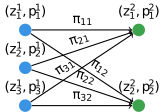
Fig. 8.1 The calculation of the Wasserstein distance for two discrete distributions as an optimal flow problem#
8.2.1. Clustering-based methods#
Clustering-based methods focus on using a distance metric (typically Wasserstein, but other alternative measures are also possible to be used) to aggregate (or combine) scenarios such that the distance between the scenario trees before and after the aggregation is minimal.
One example of this is the use of \(k\)-means clustering, and related variants, that instead of using an Euclidean norm to choose how elements are distributed among clusters, they utilise the Wasserstein distance. For more details, see, for example [COS20]. This is in fact known to work well in settings where considerable amounts of historical data are available, including the one in focus, which is applying hierarchical clustering to solar, demand, and wind time series.
See also
[Kau21] provides a comprehensive comparison of alternative methods for generating scenario trees from historical data by selecting data points and attributing weights to them.
One alternative type of clustering method is that proposed in [Lohndorf16] in which the clustering is done via a competitive learning approach. This iterative approach, combined with a specialised sampling technique, can mitigate issues related to artificially decreased variance as the number of dimensions increases. Figure XXX extracted from [Lohndorf16] show how the combination of competitive learning and stratified sampling can provide a richer representation of the uncertainty (in this case a bivariate log normal vector).
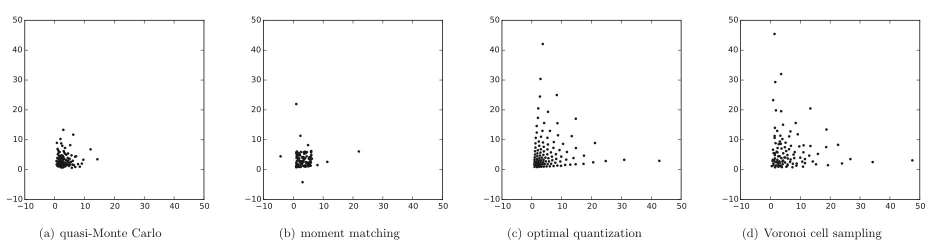
Fig. 8.2 Comparison of alternative scenario generation methods (source: [Lohndorf16])#
8.2.2. Scenario reduction#
Scenario reduction is a popular framework for generating scenario trees. As the name implies, the main idea is to obtain a scenario tree \(\xi^2\) from an original scenario tree \(\xi^1\) such that \(|\xi^2| < |\xi^1|\). To achieve that, the methods focus on ideas from the theory of stability for stochastic programming problems [Romisch03], which shows how changes in their solution in case the underlying probability distribution is perturbed. The author shows that this change can be approximated via a Fortet-Mourier-type metric whose calculation can be performed via a Monge-Kantorovich mass transportation problem, which the Wasserstein distance for discrete distributions shown in (8.2) is a special case.
Scenario reduction has seen active development in the 2000s, with not only the development of the theory supporting it but also computational tools that implemented the methods to a wider audience, which is partially the reason for its widespread success.
Chronology of scenario reduction
[DupavcovaGroweKRomisch03, HRomisch03] more or less at the same time propose the first version of the back reduction and forward selection methods, which are the two main scenario reduction methods;
[HRomisch07] then propose additional heuristic improvements to both methods;
[HRomisch09] shows that using the original methods would not guarantee representative scenario trees in the case of multistage problems and provides an updated method that can be used for multi-staged scenario trees.
There are two types of scenario reduction algorithms, namely backward reduction and forward selection, with the main difference being whether the reduced scenario tree \(|\xi|^2\) is created by subtracting or selecting from the original scenario tree \(\xi^1\). In particular, let \(K\) be the target value for \(|\xi|^2\). Then, the methods proceed as follows:
Backward reduction: repeat until \(|\xi|^2 = K\), starting from \(\xi^2 = \xi^1\):
Find the scenario whose removal causes the smallest error increase
Remove the scenario and redistribute its probability (via normalisation)
Forward selection: repeat until \(|\xi|^2 = K\), starting from \(\xi^2 = \emptyset\)
Find the scenario whose inclusion causes the largest error decrease
Add the scenario and redistribute its probability (via normalisation)
Both alternatives eventually yield a reduced scenario tree. As a general rule, forward selection tends to yield better results in terms of tree proximity but tends to be slower when \(|\xi^1|\) and/or \(K\) is large.
Scenario reduction has been shown to provide positive results as an “out-of-the-box” method for generating scenarios for stochastic programming problems, with very positive results. For example, in [HRomisch03] the authors show that with tree comprising 50% of the scenarios presented 90% accuracy whilst 1% of the scenarios was already responsible for 50% of accuracy. In addition, the implementation Scenred2 available in GAMS, with interfaces for Python and Julia, has played a prominent role in its popularisation.
Fig. 8.3 illustrates the results reported in [ONBH16], where the authors utilised scenario reduction to generate scenario trees from initial scenario samples of varied sizes. In that, one can see how the number of initial samples (\(|\xi^1|\)) affects how close the generated tree (\(K\) is represented by the shades of blue), while also showing the diminishing benefits of increasing \(K\).
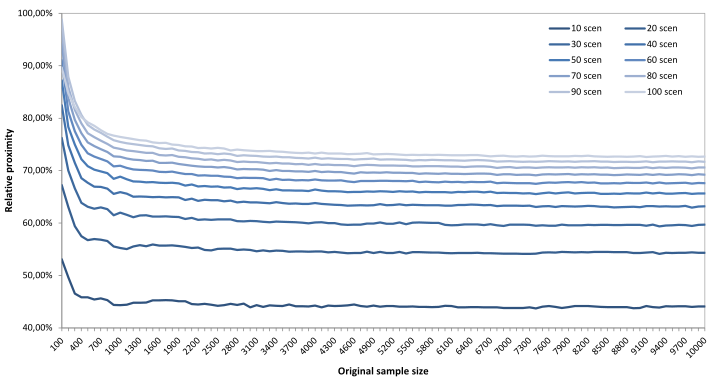
Fig. 8.3 Numerical results showing the performance of scenario reduction (source [ONBH16])#
8.3. Final remarks on scenario generation methods#
There is no universal scenario generation method that is accepted as the best performing. Indeed, the evidence in the literature is such that the best-performing method is considerably dependent on the problem. For example, in [Lohndorf16] it is clear that moment matching fails short of providing what the authors consider to be a good representation.
[Kau21] shows that scenario reduction is the best-performing method while moment matching is a closely following option. In contrast, [FernandezPerezOH18] compares scenario reduction with a quasi-Monte Carlo strategy, and finds the former to perform better than the latter.
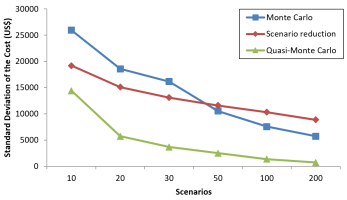
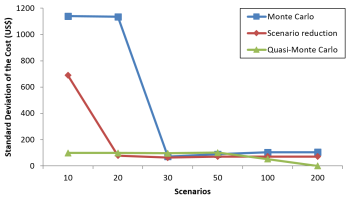
Fig. 8.4 In- (top) and out-of-sample (bottom) evaluation for three distinct scenario generation methods (source: [FernandezPerezOH18])#